
In this edition of LifeSpider™ News, you’ll see how “The Imperial Blueprint” gets installed—when belonging becomes conditional and your nervous system learns to self‑edit into a duck-shaped life—so you can name the pattern, stop outsourcing your authority, and come back to sovereignty.
Welcome, Wyrdling
There’s a pattern I keep seeing.
In institutions. In movements. In a “self-improvement” culture. And — if I’m honest — in my own inner operating system.
I call it The Imperial Blueprint.
Not empire as in history class. Imperial as in a stealth architecture of control. A design that can look like order, safety, efficiency, or even love — while quietly training people to outsource their sovereignty.
I’ve built versions of it inside myself. That’s why this goes beyond theory, politics, or culture wars for me. It’s personal. And it threads directly into my book Are You Stuck with a Duck? — that moment when you realize the Duck Pond isn’t just “out there.” It’s also a reflex you’ve been conditioned to run inside your own mind.
What the Imperial Blueprint actually is
It’s a repeating system. It defines who counts as credible, sane, safe, and worthy. It creates a narrow lane for how you’re allowed to speak, build, heal, and lead. It rewards compliance with belonging, status, and protection. It punishes deviation with shame, exile, or quiet financial starvation. And then it rewrites reality so the control starts to feel like common sense.
It doesn’t need villains. It only needs enough incentives and enough fear.
The most effective versions don’t feel oppressive at all. They feel responsible.
How the Blueprint gets installed — the Duck Pond version
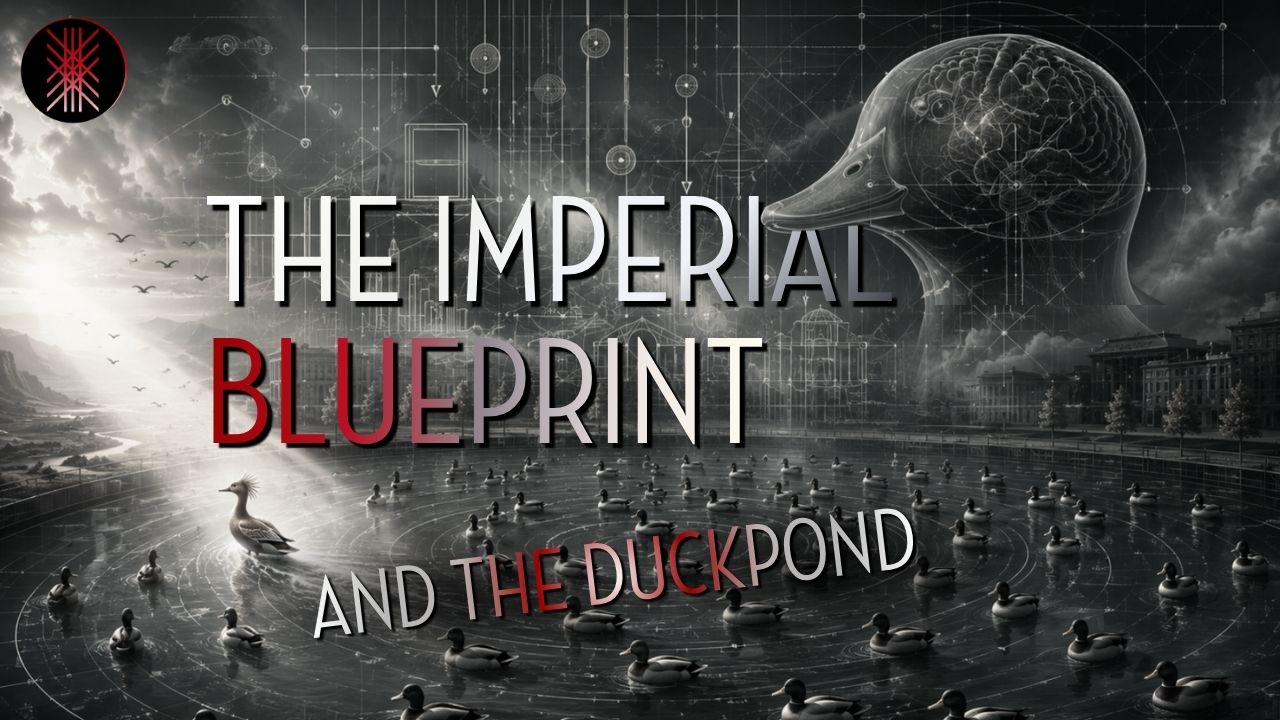
In Are You Stuck with a Duck?, the Duck Pond is the place where you learn to survive by becoming legible to the tribe. The core rule gets installed early:
Be a duck — or be alone.
It arrives through a thousand small moments. You get praised for being easy, good, and manageable. You get corrected for being too much. You get rewarded for the right tone, the right pacing, the right kind of ambition — even the right kind of pain.
Over time, the Duck Pond becomes a nervous system strategy. And once it becomes a strategy, it becomes a filter. The Imperial Blueprint doesn’t have to force you anymore. You begin to pre-censor. Pre-shrink. Pre-betray yourself — politely.
That’s the real conquest.
The part I don’t like admitting
I’ve watched myself do it.
I’ve felt the moment just before publishing something true — that brief negotiation the body tries to open:
Make it softer. Make it more normal. Make it more citable. Make it less you.
Not from deception. From something older. Some part of me that learned, a long time ago, that belonging is safer than authenticity.
The Duck Pond isn’t just a metaphor for society. It’s a pattern generator inside the psyche. And when you start to see that, you start to see the Imperial Blueprint everywhere — not only in institutions, but in the architecture of your own self-editing.
The empire logic behind AI — watch this first
I recorded something this week that sits at the center of everything above.
Not about AI as a villain. Not about technology as a threat. About something more precise: the empire logic that AI is being built inside — and why that distinction changes everything.
|
Three things I want you to take from it:
AI is a mirror. It amplifies whatever system surrounds it. Put it inside an extraction-based architecture, and it scales extraction — with breathtaking efficiency. That’s not a bug. That’s the blueprint running perfectly.
Big Tech runs on empire mechanics: take territory (data, market share), control the narrative (AGI fear, inevitability), and exploit invisible labor — the data annotators working at poverty wages whose names never appear in the press releases. None of this is accidental.
And the antidote isn’t to humanize AI. It’s to humanize the system, beginning with yourself. That internal shift, the ego learning to partner with the soul—instead of performing for the empire—is the one thing that cannot be modeled, predicted, or automated.
The Weird Ones aren’t just surviving this moment. They’re the only ones who can answer it.
The era of the Sovereign Human has begun.
P.S. The Duck Pond isn't just a metaphor — it's a full framework. Are You Stuck with a Duck? is the book behind this thread, available with a custom GPT companion for $14. If you're inside The Web of Weird, it's waiting for you there too.
THIS WEEK'S WEIRD EVENT
, Thursday, April 14, at 11:00 AM PST
Join us as we explore identity, sovereignty, self-censorship, the Duck Pond in our heads, and why The Weird Ones may be the ones built to answer this moment.
What if the system controlling people is not only “out there” — in institutions, culture, and technology — but also quietly running inside our own minds?
This week, we are exploring The Imperial Blueprint: the hidden architecture of control that teaches people to shrink, self-censor, and trade sovereignty for belonging.
For The Weird Ones, this is personal.
Many of us know the pressure to become less intense, less strange, less visionary, less ourselves — just to be accepted in the Duck Pond.
But in the age of AI, this conversation becomes even more urgent. AI is not the enemy. It amplifies the system it is built inside. So the real question is not how we humanize AI.
The real question is:
˗ˏˋ ★ ˎˊ˗ How do we humanize the system — beginning with ourselves?
If this hit a nerve, it’s because something real in you is still alive — and it wants you to act from your own authority.
If you’re one of “The Weird Ones” — the ones who don’t fit the duck-shaped mold — don’t negotiate yourself into a shape that makes other people comfortable.
Name what you are. Own what you know. Take the next true step — write the thing, say the thing, build the thing — without asking the pond for permission.

Stay Weird
Birgitta
P.S. The book, Are You Stuck with a Duck?, and this whole thread connect to the larger LifeSpider™ work around identity, coherence, and sovereign evolution.

Responses