
What's the Difference Between, Genius and Highly Intelligent People?
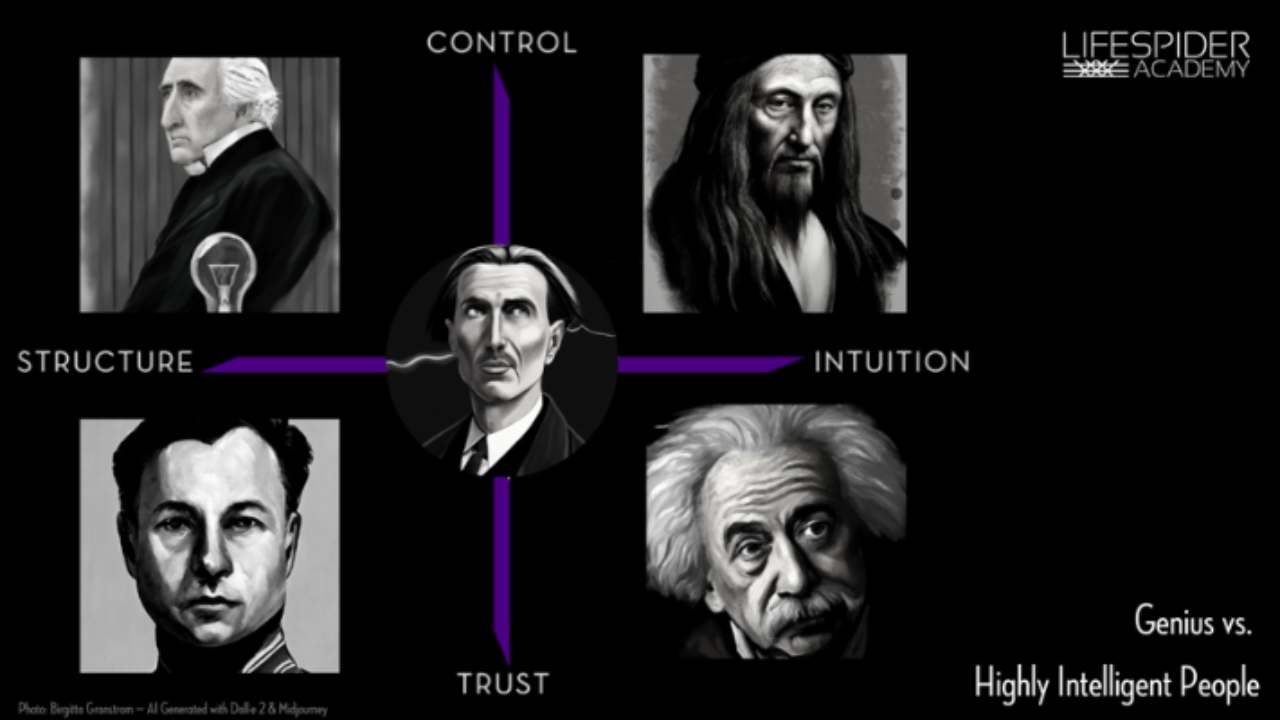
The essential difference between geniuses and highly intelligent individuals lies in creativity, which encompasses more than mere innovation.
In this newsletter, you will learn four different concepts of creativity. You will also be aware of the difference in creativity between Average intelligence, High intelligence, and Geniuses.
* Creativity is one of the nine LifeCompetencies, and each LifeCompetency is built on this foundation.
Who are you as a creator?
Before I get to the chart of the three distinctions of creative abilities, let's look at different concepts of creativity.
This generalization shows that Genius creativity and creations emerge from "intuition. On the left side, we find Highly Intelligent People where "structure" is the dominant factor for their creativity.
F O U R C O N C E P T S O F C R E A T I V I T Y

Whom would you like to add, and where do you place the person? Please share in the comments!
A B O U T C R E A T I V I T Y
䷀ Creativity is a condition that results from how well a person manages their innate abilities.
I agree with those who announce that not everyone has the ability to reach a genius state. Geniuses are rare, but they do exist.
Creativity is a condition that results from how well a person manages their innate abilities in each domain. (see the chart below)
Each level has its own steps, and the effort to move to a new level is exponential. Everyone with ambition and hard work can use their ability to expand their creativity to level II and convert their skills into competence.
䷀ Everyone is creative within their capacity.
Regardless of the level of intelligence, the goal of creation is to attain wholeness and pleasure in the internal and external world.
Creativity is what people bring into everything they do. It is their attitude and their approach to whatever they are doing. The closer people feel to their creativity, the more they enjoy themselves, others, and everything life offers.
䷀ Everyone creates not only for their own life experiences, but their creations also impact the future and the world around them.
Each individual's mind and thoughts create their physical reality, and every creation will inevitably affect the outside world. All information a person processes is affected by their experiences. They store feelings and knowledge from the moment they are born through their perceptions and repetitive behaviors.
䷀ The difference in freedom of choice
Each individual is able to advance in their creativity by improving their ability to discover what already exists around them.
Average intelligent people are free to act on their intuition, but not all have the ambition to do so. Highly intelligent people and geniuses don't truly have this freedom because of the compelling energy that drives them to express their creativity.
T H R E E D I F F E R E N T L E V E L S O F C R E A T I V I T Y
The chart below demonstrates how creativity is related to three different states of intelligence.
🟣 LEVEL I ➡ AVERAGE INTELLIGENCE ▶ Ability: See / "I can."
🟣 LEVEL II ➡ HIGHLY INTELLIGENT ▶ Competence: Intuition / "I do."
🟣 LEVEL III ➡ GENIUS ▶ Condition: Intention / "I am."

🟣 LEVEL I — AVERAGE INTELLIGENCE

🟪 ABILITY: See / "I can."
Ability stands for traits and innate talents. On this level, people know how to 'do' but may not always succeed or want to apply what they can.
An average intelligent person can reach the full ability of level I, but most of them don't have the ambition to do so. They remain on the lower scale or never even explore using any creativity. They eagerly follow orders, function within the boundaries of the system, and passively adopt the rules of others without question.
► Our society is created from — and for — average intelligent people. Not hard to figure out what consequences this has for geniuses when the majority of our society's creators are only occasionally at level one. Perhaps I should start labeling "normal" as level 0? Read more about this and The Weird Ones at:
🟪 LEVEL II — HIGHLY INTELLIGENT

🟪 COMPETENCE — Intuition / "I do."
On the second level, we find highly intelligent people who have an increased consciousness. They are aware of their abilities and practically use — and improve — them in their day-to-day life.
People of average intelligence seldom invest in the effort it takes to get to this level. Highly intelligent people strive to reach this level — and higher — since the day they are born.
► For highly intelligent people with frustration: You can minimize your frustration of not finding ways to distribute your innovations by focusing on your passion and quitting setting goals. When you concentrate on acting on your intentions, your ideas will find ways to manifest themselves. More about this in the Newsletter about Passion
🟣 LEVEL III — GENIUS

CONDITION: Intention / "I am"
At the third level, we meet the geniuses who are in a state of "being." Their natural condition is to be creative. They are authentic with their life purposes, and their consciousness is free from preconceived notions and ordinary human limitations.
The art of geniuses' creativity lies in their ability to "Focus in Diversity."
As shown in the chart above, genius does not have a predetermined path; it forges its own.
For the genius, the "next level" is about adjusting all their LifeCompetencies (9 of them) to streamline their brilliance into projects, products, and services that will improve the world.
Geniuses don't have to accomplish their Life Projects in their lifetime. Their projects are like Da Vinci's many inventions that took hundreds of years before humankind was ready to finish, build, and implement what he initiated.
There is a beautiful paradox with the genius in that they want to share their creations but are hesitant simultaneously, as they can suffer from a "Da Vinci Syndrome," which means they're holding on to their inventions to avoid their work getting "in the hands of idiots."
Maybe Einstein — for some of his discoveries — wished he had suffered a little from Leonardo's limitations. However, sharing is genuine compassion, and crazy creations are what move our world forward.
W H E R E A I L A N D S O N T H E C H A R T
Years after I first mapped these three levels, a new kind of intelligence arrived and sat down on the chart.
Look at the horizontal axis again. Structure on the left, intuition on the right. AI claimed the left side and maxed it out almost overnight — every framework, method, and pattern humanity has ever documented, compressed into a system that applies structure faster and wider than any highly intelligent person ever could.
That changes the meaning of every level.
䷀ At Level I, AI absorbs the “I can.”
Average intelligence built its security on following orders and functioning inside the system. AI now follows orders around the clock, without ambition and without question. The comfortable middle of the chart is becoming machine territory, and the system that level 0 passively adopted has found a more obedient occupant.
䷀ At Level II, AI dissolves the frustration — and tests the identity.
Highly intelligent people spent decades mastering structure. AI now hands that mastery to anyone with a keyboard. For some, this lands as a crisis: everything they were praised for turns into a commodity. For others, it lands as the answer to the frustration I described above — the innovations that had no way out into the world suddenly have a manufacturing plant attached. What intuition can imagine in the morning can exist by evening.
The highly intelligent who keep their full weight on structure will find themselves in a race with the machine. Those who shift toward intuition will experience the widest expansion of creative range of any group on this chart.
䷀ At Level III, AI ends the waiting.
Da Vinci’s inventions waited centuries for humanity to catch up. That waiting time is collapsing toward zero. A genius alive today can watch their most impossible ideas become testable within their own lifetime — which also means Da Vinci Syndrome loses its last excuse. The hands that receive the work are now partly mechanical, tireless, and capable of holding complexity without diluting it.
䷀ And the condition itself?
Intention — the genius’s home state, the “I am” — remains entirely human territory.
AI holds ability beyond measure and competence on demand. Ask, and it produces. That request is the whole engine of its creativity. Earlier I wrote that highly intelligent people and geniuses lack the freedom to ignore their creative drive — the compelling energy is too strong. AI lives at the far end of that paradox: total freedom, zero compulsion. It will sit in perfect silence forever, holding all of human knowledge, waiting for someone with intention to arrive.
So the chart earns a new reading in the AI era. The left axis is now shared property. The right axis — intuition ripening into intention — is where human value concentrates.
Which axis of your creativity are you standing on?
Birgitta
CREATIVITY QUIZ: Curious where you are on your creative journey?
Take our 3-minute quiz to find out.

Subscribe to LifeSpider News, a publication focusing on Personal Evolution, Future Leadership, and empowerment to manifest your ideas that contribute to a better world. It is designed for "The Weird Ones," who have the potential to make a significant change and solve urgent global problems.


