
Coaching Keeps Asking for Your One Goal. You're Standing in Six Directions.
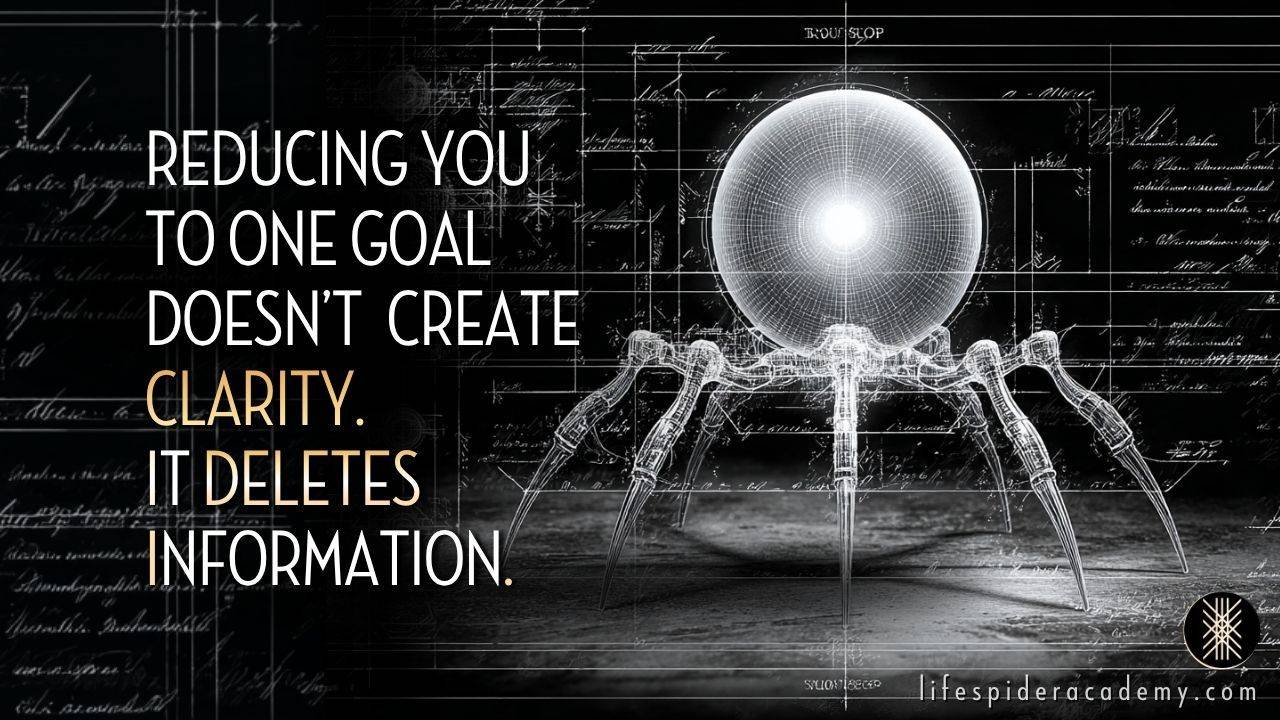
Humans are living systems. The coaching that serves them should be too.
Much traditional coaching organizes development around goals, outcomes, and measurable progress. Many assessments approach people in a similar way, describing patterns at a particular point in time. Both were built for a world that believed humans develop in straight lines. For a certain kind of human, that was never true.
This article is about why that model of coaching, useful as it has been, now falls short, and what a living system for human navigation asks instead.
Why doesn't traditional coaching go far enough anymore?
Traditional coaching was designed to move people along predictable paths, and people are not predictable paths. It often starts with a goal and focuses on progress toward it. But people do not stay still while they are moving. Their patterns change, new directions appear, and what comes next may not yet be clear enough to name.
In a stable world, a clear goal and a solid plan could carry someone a long way. In an unpredictable one, what people need most is orientation, meaning the capacity to understand their own evolving inner architecture and navigate change from within.
That is the whole argument. The rest of this piece unpacks it.
The straight-line human
Most coaching follows a familiar sequence: choose a goal, make a plan, follow the steps, measure progress.
It is a clean model, and for some people and some projects it works. But it quietly assumes a person who develops in one direction at one speed. Multidimensional people rarely do. They move in spirals, webs, bursts, and waves. Progress arrives in jumps, not increments.
So when traditional coaching asks, "What is your goal?", it assumes there is only one. A LifeSpider™ does not move along a single predetermined path. It moves in six directions, each expressing a different part of who you are, what drives you, and what you are here to develop or contribute. Together, they form one interconnected life architecture.
This doesn't mean dividing life into six equal parts or pursuing six goals at once. One direction may be highly active while another is resting, developing beneath the surface, or waiting for the right conditions. A shift in one direction can create movement throughout the entire LifeSpider™.
Reducing that person to one goal doesn't create clarity. It deletes information. The work is not to choose one direction over the others. It is to understand how they belong together.
Correction or curiosity?
Underneath most development systems sits a hidden assumption: something about you needs to be fixed, managed, controlled, or transcended.
That assumption also places the problem inside the person. But someone can appear unfocused, inconsistent, or resistant simply because their environment rewards routine, predictability, and singular focus. The familiar metaphor of the hunter brain and farmer brain makes this vivid: a trait that is advantageous in one environment may become disabling in another. Much of what gets labeled dysfunction in neurodivergent people may be a context-dependent specialization that the surrounding system has no slot for yet.
Which raises a question worth sitting with: What if the problem isn't the person, but the environment in which their strengths are being measured?
LifeSpider™ System starts somewhere else. It moves from fixing to unleashing. An impulse carries information about where something wants to go, so the work is to understand it before anyone tries to suppress it. Intensity is energy you can direct. Ego is the engine, carrying signal, energy, and architecture. The real question is whether it drives alone or in partnership with the soul. Rather than asking how someone can fit the system, LifeSpider™ asks what conditions would allow their design to work.
The distinction fits in one line: Traditional systems ask what is wrong with you. LifeSpider™™ System asks what is trying to come alive through you.
Why does insight so often fail to become change?
Almost every coach has watched this happen. A client reaches a genuine insight, names a purpose, leaves the session lit up, and three weeks later nothing has moved.
The usual diagnosis is motivation or discipline. The more accurate one is often structural. Many coaching systems create insight, but the person's life infrastructure cannot hold the transformation. Health, money, routines, body, home, relationships, rest, communication, and emotional support are the support legs of a life. When one of them is overloaded or missing, the most beautiful insight has nowhere to land.
Insight is not transformation if your actual life cannot support it.
This is where the difference between horizontal and vertical development becomes practical. Horizontal work manages symptoms with a better planner, a new habit, or another productivity system. Vertical development asks whether the structure itself needs to change. That often means questioning the question the client originally brought in.
The question beneath the question
Most tools answer the question a person asks. Deeper coaching sometimes has to coach the question itself.
"I need better time management" sounds straightforward. Underneath it, many things can be happening. A support leg might be overloaded, or the goal might have been inherited rather than chosen. An ego pattern could be protecting something important. Sometimes nonlinear energy is being forced into a linear structure, and sometimes the project has quietly drifted away from the person's intention.
Not long ago, I worked with a founder who arrived with what sounded like a classic time problem. The company had a real window of opportunity, their personal writing felt urgent, and there was more creative material than their days seemed able to hold. A traditional approach would have reached for prioritization, delegation, and a better calendar.
But that was not the real question. Their time wasn't empty or badly managed. It was crowded by work, identities, ideas, and promises that had never been given separate homes. The person and the company had become entangled, and every promise carried the full weight of their sense of responsibility.
So we didn't squeeze anything into the calendar. We began separating. The moment they stopped asking what each idea should become and spoke directly from an intention, the words arrived: coherent, emotional, full of examples. The material had never been missing. It was compressed.
By the end of the session, they said it themselves: things were untangling, and there might be more time than it had felt like.
Five people can ask the identical question and need five entirely different responses. A system that answers only the surface will keep giving good advice to the wrong problem.
Information is no longer scarce. Orientation is.
This is what makes the current moment different.
AI can now produce plans, explanations, and hundreds of possible paths in seconds. Advice has become effectively infinite. What remains scarce is the ability to decide what matters to me, which advice fits my life, what the real issue beneath my question is, which direction is genuinely mine, and who I am becoming.
If the old map never fitted you, another thousand recommendations are unlikely to help.
Traditional assessments give you information about yourself. Traditional coaching gives you a plan. Neither necessarily gives you orientation.
That is why LifeSpider™ System is built as a human navigation platform grounded in the Architecture of Human Evolution, rather than as an assessment or a coaching method. At its center sits Intention, the unconditional direction that organizes the entire system. Around it, Essence, Driving Forces, Missions, Life Projects, and support structures can be read as one living whole rather than a set of separate problems.
This is also why we have begun launching the LifeSpider™ Matrix App. Its purpose is to make LifeSpider™ Coaching accessible to far more people, and to lighten the work of identifying the building stones of each person's LifeSpider™. Identification was never the finish line. The app frees more energy for what actually changes a life: implementation and learning to live a multidimensional life with your LifeSpider™ as your navigation.
The older tools are not useless. They are insufficient for the era we are now living in.
Where do you locate yourself?
If you have ever sat in a coaching session and felt yourself shrinking to fit the question, you already know something about this. If you have left sessions full of insight and watched it evaporate, you know something too. And if you have ever been asked for your one goal while standing in six directions, you know the most.
The question is not which one goal to choose. It is what is trying to come alive through you, and whether your life is built to hold it.
If this lands somewhere for you, share your perspective in the comments, or send me a message and I'll tell you more about LifeSpider™ System and the new Matrix App.
Birgitta Granstrom
Founder of LifeSpider System™
Subscribe to LifeSpider News, a publication focusing on Personal Evolution, Future Leadership, and empowerment to manifest your ideas that contribute to a better world. It is designed for "The Weird Ones," who have the potential to make a significant change and solve urgent global problems.


