
The Architecture of Weird: Polymaths, Neurosicesity & Systems Thinking

"If you've ever been told you're too much, too intense, too curious, or too different—chances are, you're exactly what the future needs."
You've been told to "pick a lane" so many times you've lost count. Focus. Specialize. Go deep, not wide. Build expertise in one thing.
And every time you hear it, something inside you recoils—not because you're undisciplined, but because the advice is fundamentally wrong for how you're built.
Because here's what they don't understand: Your mind doesn't wander across multiple domains. It synthesizes across them. When you move from quantum physics to medieval poetry to organizational design, you're not scattered—you're building a multidimensional map that reveals patterns invisible to specialists. What looks like a distraction from the outside is actually integration from the inside.
But try explaining that to a world organized around silos, hierarchies, and singular expertise.
So you've probably tried to fix yourself. Maybe you've worked with coaches who helped you "prioritize" (translation: amputate the parts of you that don't fit a marketable narrative). Or you've explored personal development frameworks that promised self-actualization—if only you'd climb their ladder, one rung at a time, suppressing your hunger for simultaneous, multidirectional growth.
Perhaps you've found some relief in neurodivergent communities. Finally, people who understand that your brain works differently. Except... those frameworks still don't quite fit either. Because while you may share traits with ADHD or autism—the hyperfocus, the sensory intensity, the pattern recognition—those diagnoses were built to identify deficits, not decode evolutionary architecture.
You don't need accommodation for a disorder.
You need the correct operating system for your actual design.
The Missing Framework: What Polymaths Actually Are
The word "polymath" has been sanitized into "someone with many interests"—a nice way to describe a dabbler with good intentions. But that's not what you are.
True polymaths aren't collectors of hobbies. They're synthesizers whose minds demand integration across seemingly unrelated fields because they perceive the underlying connective tissue that specialists miss.
And here's what conventional frameworks—both personal development and neurodivergent models—fail to account for:
Your complexity isn't something to manage. It's something to activate.
Because you're not just a polymath. You're operating with three interlocking capacities that, together, create an entirely different kind of consciousness:
1. Polymath Nature – You're drawn to multiple domains not randomly, but because your mind is designed for cross-domain synthesis. Where others see separate fields, you see relationships, resonances, and recursive patterns.
2. Neurosicesity – This isn't neurodiversity in the general sense—the umbrella term that includes ADHD, autism, dyslexia, and other neurological variations. This is something more specific: a non-optional neurological necessity for deep, multi-level stimulation and conscious complexity. Your nervous system doesn't just tolerate nuance—it requires it to function. When that need isn't met, you don't just get bored. You deteriorate.
3. Systems Thinking – You don't think in ladders. You think in webs. Your cognition is inherently holographic: you see wholes, patterns, feedback loops, and emergent properties. Linear models literally cannot contain how you process reality.
When these three capacities combine, you get what I call The Weird Ones: people who aren't broken versions of normal, but early iterations of what's next.
Neurosicesity

Pronunciation: noor-oh-sih-SESS-ih-tee

Definition: A non-optional neurological requirement for deep, multi-level stimulation and conscious complexity; the condition of a nervous system that does not merely tolerate nuance but requires it to function optimally.

Unlike neurodiversity (an umbrella term for neurological differences), neurosicesity describes a specific phenomenon: the brain's non-negotiable demand for complexity. A person with neurosicesity doesn't just get bored without stimulation—they deteriorate. Their cognitive and emotional systems require constant multi-threaded engagement the way lungs require oxygen.
You're in Good Company
Before we go further, let me ground this in reality—not theory.

Before we go further, let me ground this in reality—not theory.
Ada Lovelace, mathematician and daughter of Lord Byron, wrote the world's first computer algorithm in 1843—nearly a century before computers existed. Her polymath mind wove together mathematics, poetry, and mechanical engineering to envision what she called "poetical science": machines that could create music and art, not just calculate. She saw systems and possibilities others couldn't perceive because she refused to think in disciplinary silos. Her neurosicesity—intense focus, severe health challenges, obsessive pattern-seeking—gave her the perceptual apparatus to imagine artificial intelligence before the word "computer" existed.
Leonardo da Vinci never finished most of his commissions. Historians now recognize this wasn't laziness but likely ADHD-type traits: his polymath mind couldn't be contained by single projects when he was simultaneously revolutionizing art, engineering, anatomy, and architecture. His "scattered focus" gave us the Renaissance.
Nikola Tesla had extreme sensory sensitivities and obsessive rituals that would today be labeled autistic traits. His neurosicesity—his heightened perceptual apparatus—let him visualize entire electrical systems in his mind with such precision he could build them without blueprints.
Isaac Newton's social isolation, rigidity, and hyperfocus made him "difficult." It also let him invent calculus, revolutionize physics, and spend decades in solitary pursuit of patterns others couldn't perceive.
These weren't people who "overcame" their wiring. They were people whose polymath nature, neurosicesity, and systems thinking created their genius—when they stopped trying to fit into frameworks designed for different cognitive architectures.
The question isn't whether you belong in this lineage.
The question is: What happens when you finally operate from your actual design instead of trying to fix what was never broken?
The Operational Problem: Knowing Your Design Isn't Enough
So now you know. You're a polymath with neurosicesity who thinks in systems.
But here's where most explorations of "different cognitive wiring" stop—right at recognition. You get validated, maybe find your tribe, and collect some new vocabulary for your experience. And then... what?
Because knowing you're not broken doesn't automatically tell you how to operate.
In fact, it often makes things worse. Now you're aware that conventional frameworks don't fit you, but you're still trying to use them because they're all that's available. You're a complex multidimensional system trying to run on linear software.
Personal development tells you to work on "one goal at a time." But your six current projects aren't distractions from each other—they're feeding each other. The novel you're writing informs your approach to organizational leadership. Your study of mycelial networks is reshaping how you think about community building. Your exploration of quantum mechanics is shifting how you understand human relationships.
Kill five projects to focus on one? You'd be amputating the very synthesis that makes your thinking valuable.
Neurodivergent frameworks offer coping strategies: manage your overstimulation, work with your executive function challenges, and find accommodations. All useful. But accommodations are for getting through existing systems. What you actually need is a system designed for how you're built.
Because here's what I've learned working with Weird Ones for nearly two decades:
You don't have a focus problem. You have a framework problem.
Your mind is already organized—just not linearly. You're already integrated—just not hierarchically. You already have coherence—it's just multidimensional.
What you need isn't discipline. It's the correct architecture.
Holistic frameworks that acknowledge multiple life areas—but still organize them hierarchically (spiritual development at the top, physical at the bottom, as if your body is less evolved than your consciousness).
Systems thinking models that map complexity beautifully—but offer no operational guidance for living as a complex system day-to-day.
Integral approaches that honor multiple dimensions—but still assume you're building toward something rather than already operating as something.
The difference with LifeSpider™ isn't philosophical. It's architectural.
Every other framework asks: "How do we help complex people navigate simple systems?"
LifeSpider™ asks : "What does a system look like that's designed for how complex people actually function?"
Not multiple life areas you balance.
Not developmental stages you climb.
Not competing priorities you manage.
Six simultaneous purposes. Operating as one living system. Right now.
Enter the LifeSpider: Your Native Operating System
Imagine for a moment that your life isn't a ladder to climb or a wheel to balance.
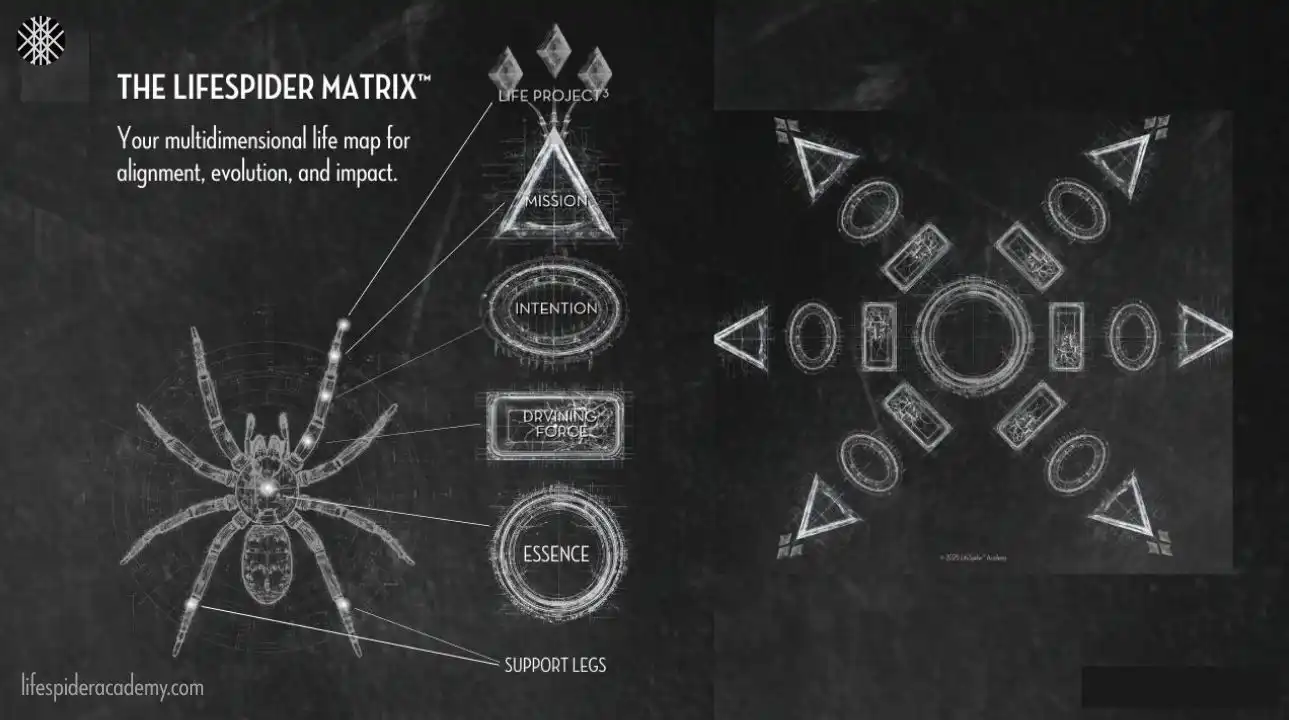
Imagine it's a web.
Not a web as a metaphor. A web as actual structure—six distinct legs, each representing a different purpose, all radiating from your center, all connected, all active simultaneously.
This is the LifeSpider™ System, and it's not something I invented to help polymaths. It's something I discovered by watching how polymaths actually function when they stop trying to be linear.
Here's how it works:
Six Purposes (the legs):
Each leg of your LifeSpider represents a distinct soul-level contribution to planetary or species evolution—not a "life area" like "career" or "health," but an actual evolutionary purpose you're here to serve. For a Weird One, these might look like:
- Expand human consciousness beyond physical limitation
- Restore symbiotic relationship between humanity and living systems
- Eliminate suffering through accessible transformation
- Decode the architecture of human thriving
- Democratize wisdom that's been kept behind gatekeepers
- Integrate ancient knowing with emerging technology
These aren't abstract aspirations. They're non-negotiable soul contracts—what you're here to contribute to the evolution of consciousness, species, or planet.
Within each purpose, you build specific Life Projects—the businesses, creative bodies of work, communities, or systems that execute the purpose in practical reality. These projects aren't separate pursuits competing for your attention. They're simultaneous expressions of your evolutionary commitments. Your LifeSpider doesn't activate one leg at a time—it pulses across all six, different intensities at different moments, creating a living system of momentum.
Three Core Components (per leg):
Each purpose operates through three interlocking elements:
- Driving Force – The specific egoic force that powers this purpose (not something to suppress, but sacred fuel to channel)
- Intention – The conscious direction you're setting
- Mission – The unique contribution this purpose makes
Where conventional frameworks ask you to have "one life purpose," your LifeSpider recognizes you have six active missions, each fed by different aspects of your ego, each contributing to a larger pattern only you can see.
A word about Driving Forces—our Ego—because this is where most frameworks get it catastrophically wrong:
You've been taught that ego is the problem. Spiritual traditions tell you to transcend it. Personal development tells you to manage it. Corporate culture tells you to hide it behind "professionalism."
All of them are asking you to cut off your fuel supply.
Because Driving Forces aren't personality flaws—they're energetic engines. Each of your six purposes runs on a specific egoic force. Your particular ego might express as Ruthless clarity that cuts through noise, Celebrity magnetism that draws attention to your work, Diva precision that refuses to compromise standards, Manipulative strategy that shapes outcomes, Greedy appetite that claims what's yours, or Dictator authority that commands respect. Everyone's configuration is different.
Suppress these forces? You don't become more evolved—you become anemic. Your purposes sputter. Your projects lack fuel. You end up in what I call "prostitution projects"—work you take on to fund your real purpose because you've cut yourself off from the ego that would power it directly.
Channel these forces consciously? Each Driving Force becomes precision fuel for its corresponding purpose. Not toxic. Not reckless. Purposeful.
This is integration, not suppression. And it's non-negotiable for operating your LifeSpider™ at full capacity.
The Web (integration):
This is where systems thinking comes alive. Your six purposes aren't isolated pursuits competing for time and attention. They're nodes in a network, feeding each other information, energy, insight. The web between them is where your synthesis happens—where the medieval poetry does inform the quantum physics, where the organizational design does emerge from the mycelial networks.
Your polymath nature isn't a bug. It's the web itself.
Your neurosicesity isn't overstimulation. It's the sensitivity that lets you feel when the web needs adjustment, when a leg needs activation, when the whole system is out of resonance.
Your systems thinking isn't complexity for complexity's sake. It's how you perceive the actual architecture of your life.
The Inner Operating System (LifeCompetencies):
Your six purposes need more than direction—they need functional architecture. LifeCompetencies maps the nine fundamental human capacities (understood through ability, competence, and condition) that determine where your energy flows naturally, where it leaks, and where internal conflicts drain you before you even start.
Think of it as the difference between knowing you need a web (LifeSpider™ structure) and knowing how to run that web without your purposes cannibalizing each other (LifeCompetencies navigation).
This is advanced territory—most people need to map their six purposes first before diving into the operating system underneath. But know it exists. It's what prevents even sophisticated LifeSpiders™ from burning out.
Why This Changes Everything
When polymaths try to operate from linear models, they experience constant cognitive dissonance. "I should focus on my career" feels wrong because three of your purposes are currently cross-pollinating in ways that will revolutionize your work—but only if you let them.
"I need to finish this before starting that" feels like violence because your mind doesn't work sequentially. It works constellationally—different elements activating in response to what the whole system needs.
The LifeSpider doesn't ask you to change how you're wired.
It gives you a framework that matches your wiring.
Suddenly, having six active projects isn't proof you can't focus. It's evidence your LifeSpider™ is fully activated.
Suddenly, your need for complexity isn't something to manage. It's neurosicesity demanding you operate at the level you're designed for.
Suddenly, your ability to see connections everywhere isn't a distraction. It's your web doing exactly what it's supposed to do.
You're not scattered across multiple domains.
You're integrated across a multidimensional system.
And the moment you start operating from that truth—not as aspiration, but as architecture—everything shifts.
What Happens When You Stop Apologizing for Your Architecture
Here's what I've watched happen when The Weird Ones finally operate from their LifeSpider™ instead of fighting it:
The work changes form.
Not "I'm finally productive" but "I'm finally building what I was designed to build." Projects that seemed impossible under linear constraints become executable when you stop trying to sequence them. The novel, the consulting practice, the research, the community—they stop competing and start feeding each other. You're not doing more. You're doing differently.
The exhaustion reveals its source.
Turns out you weren't tired from complexity. You were tired from suppressing complexity while pretending to be simple. The moment you activate all six legs simultaneously—different intensities, yes, but all online—the nervous system stops screaming. Neurosicesity isn't overstimulation. It's understimulation trying to look like overstimulation.
The imposter syndrome evaporates.
Not because you suddenly feel "worthy" but because you stop measuring yourself against standards designed for different cognitive architectures. A web doesn't compare itself to a ladder. Once you see your actual structure, the shame vanishes. What remains is curiosity: How sophisticated can I make this system?
Most importantly—the synthesis accelerates beyond anything you thought possible.
Because when you're not spending energy trying to pick one thing, suppress five others, and apologize for being "all over the place," all that liberated energy goes into what you were designed to do: connect what others separate.
Your six purposes start cross-pollinating in ways that would be impossible if you'd forced yourself into singular focus. The patterns you see across domains become your competitive advantage. The connections you make that others miss become your unique value proposition. The multidimensional thinking that once seemed like a liability becomes the exact capability the future needs.
You don't become more focused.
You become more fully activated.
And activation—not optimization, not balance, not management—is what evolution looks like for a Weird One.
What This Looks Like in Practice: The 20-Year Project That Waited for the World to Catch Up
Let me show you what multidimensional activation actually looks like—not in theory, but in lived reality.
One leg of my LifeSpider™ carries the purpose: Reveal the Science of Life.
Twenty years ago, I started building something I called LifeCompetencies—a framework that categorizes all human behavior based on frequency. I had no idea what I was doing. I just knew there was a pattern, a system, an operating architecture to human development that wasn't being named. So I mapped it.
LifeCompetencies became what I now recognize as an operating system for human life: nine fundamental capacities (each understood through ability, competence, and condition) that show where energy flows naturally, where it leaks, where misalignment creates friction, and where untapped potential waits. Just as a computer OS allocates memory and prevents crashes, LifeCompetencies helps you allocate energy consciously and recognize internal conflicts before they turn into burnout.
I tried to build assessments manually. Too complex. I needed a programmer. Didn't know any. Couldn't explain what I wanted to create. So I... moved on.
A decade passed.
The LifeSpider System emerged as a separate framework. I thought LifeCompetencies didn't belong with it—too different, too technical. I was active in other legs of my spider: building coaching methodologies, working with clients, and developing the language of Driving Egos.
Then I realized: LifeCompetencies wasn't separate from LifeSpider™ at all—it was always meant to be the navigation layer, the inner architecture I'd mentioned earlier. The two frameworks had been waiting to integrate. The navigation layer. The inner architecture that ensures your six purposes, intentions, and missions actually function coherently rather than cannibalize each other.
But I still couldn't build it. The technology didn't exist—or I didn't have access to it.
So I sat on it. Tested pieces with a few clients. Waited.
I met AI. Became a beta tester for ChatGPT's code version. Got hopeful. Tried to get it to build what I could see in my mind. Too complicated. The gap between my vision and what the tool could execute was still too wide.
And here's the thing about operating as a LifeSpider that linear models miss:
I was never anxious about "not accomplishing."
Because while that leg was waiting for technology to evolve, I was fully activated in other legs. Building. Writing. Teaching. Creating frameworks people could use now. My web kept pulsing. Different projects at different intensities. No leg was abandoned—some just operate on longer timescales than others.
Da Vinci's helicopter took 500 years before the world was ready for it. I figured my timeline might be 50 years. (Thanks to AI, it's looking more like 5.)
Then Claude Code arrived.
Suddenly, what I'd been carrying for two decades—this complete vision of an operating system for human development—became executable. Without me learning to code. Without me hiring a team. The technology finally caught up to what I'd perceived 20 years ago.
LifeCompetencies is now growing. Activating. Becoming real in the world.
And here's where the Driving Ego piece becomes critical:
The ego powering this leg? Entitled.
Not entitled in the toxic sense—entitled in the sacred sense. The bone-deep knowing that I have the right to build this, to teach this, to stand in front of anyone on the planet and speak with complete confidence about how human architecture actually works for Weird Ones.
Not because I'm special. Because I've done the work. Because I've held the vision for 20 years. Because I trusted my perception even when I couldn't execute it yet. Because I let it wait instead of forcing it prematurely or abandoning it entirely.
This is what LifeSpider activation looks like:
- Six purposes operate simultaneously, not sequentially
- Different timescales for different projects (some move fast, some wait for decades)
- No burnout from "doing too much" because you're not suppressing five things to focus on one
- Driving Egos as sacred fuel (Entitled giving me unshakeable confidence, not arrogance)
- Systems thinking that sees how LifeCompetencies and LifeSpider aren't separate but integrated
- Polymath synthesis across psychology, spirituality, technology, and systems design
- Neurosicesity that required this level of complexity to stay engaged
I didn't need to pick a lane. I needed to activate the whole web.
And when one leg finally aligned with the right technology, two decades of held vision became executable in months.
That's not patience. That's architecture.
The Invitation (Not the Sales Pitch)
I'm not going to tell you that you need LifeSpider™ System.
If you've read this far and felt the recognition—that specific resonance of "Oh. This is what I've been missing"—then you already know whether this is for you.
The question isn't whether you're ready for a new framework.
The question is: Are you done trying to make linear systems work for a multidimensional mind?
Because here's what happens next if you are:
You start mapping your actual LifeSpider™. Not the life you think you should be living, but the six purposes that are already active, already pulling at you, already forming a pattern you've been too busy apologizing for to actually see.
You identify which Driving Egos are powering each LifeSpider™ leg—and instead of suppressing them (the "spiritual" approach) or letting them run wild (the "authentic" approach), you learn to channel them as the sacred fuel they are.
You discover where your web is strong, where it needs reinforcement, where you've been abandoning entire legs because someone told you to "prioritize."
And then you activate the whole damn system.
Not all at once in a blaze of unsustainable intensity. But with the kind of sophisticated, rhythmic attention that only a systems thinker can bring. You learn to feel which leg needs focus today, which purposes are cross-pollinating this week, when the whole web needs rest versus when it needs full activation.
This is the work.
Not figuring out which parts of you to cut away, but learning how all of you work together.
Where The Weird Ones Gather
If you're thinking: "Yes. I recognize myself completely. I'm ready to map my actual architecture and stop apologizing for it"—
→ Join The Web of Weird as a founding member. Full transparency: this is early-stage community building. You won't find hundreds of polymaths in there yet—you'll find me, the framework content, and the first cohort of Weird Ones brave enough to claim their spot before the crowd arrives.
What you GET: Direct access to LifeSpider™ framework materials, my active engagement as founder (not some scaled-back version once it's "too big"), and the chance to shape what this community becomes. You'll be the ones other people meet when they join later.
What you DON'T get: An already-thriving forum of hundreds. That's what we're building together.
If you need the community to already exist before you join it, take the assessment first and come back when we're further along. If you're ready to be part of the founding architecture, not just consume what others built—this is your moment.
If you're thinking: "This resonates deeply, but I need to confirm I'm actually one of these people before I commit"—
Take the "Are You Weird Enough?" assessment. It's not a quiz to make you feel special. It's a diagnostic to see if you actually have the polymath-neurosicesity-systems thinking combination, or if you're someone who just enjoys variety (nothing wrong with that—but the LifeSpider™ would be overkill).
If you're thinking: "I want to understand the full framework architecture before deciding anything"—
Download the Evolutionary Leap guide. This is the complete LifeSpider™ framework that reveals your Soul's Architecture and how to activate your multidimensional potential. It's comprehensive. It's unapologetic about complexity. And it will either confirm you're in the right place or clarify that you're not.
If you're thinking: "I need to see this isn't just theory—I need proof that others like me exist and are actually doing this"—
Read the historical lineage. Ada Lovelace. Leonardo. Tesla. Newton. They're not metaphors—they're your actual predecessors. See how the Weird Ones have always operated.
→ Read: The Meaning of Weird - Do You Belong?
The Real Question
I'm not asking you to believe in LifeSpider™ System.
I'm asking you to stop pretending you're not already operating as one.
Your six purposes? Already active. Your need for complexity? Already non-negotiable. Your systems-level perception? Already how you see the world.
The only question is: Will you keep apologizing for your architecture, or will you finally activate it?
Because the world doesn't need another specialist who knows one thing deeply.
It needs polymaths who can synthesize across domains, systems thinkers who can see the patterns specialists miss, and Weird Ones brave enough to operate from their full complexity instead of their marketable fraction.
That's you.
The framework is here when you're ready.
And if you're the kind of person who'd rather shape something from the beginning than consume what others built—now is actually the perfect time. / Birgitta Granstrom
Subscribe to LifeSpider News, a publication focusing on Personal Evolution, Future Leadership, and empowerment to manifest your ideas that contribute to a better world. It is designed for "The Weird Ones," who have the potential to make a significant change and solve urgent global problems.


